
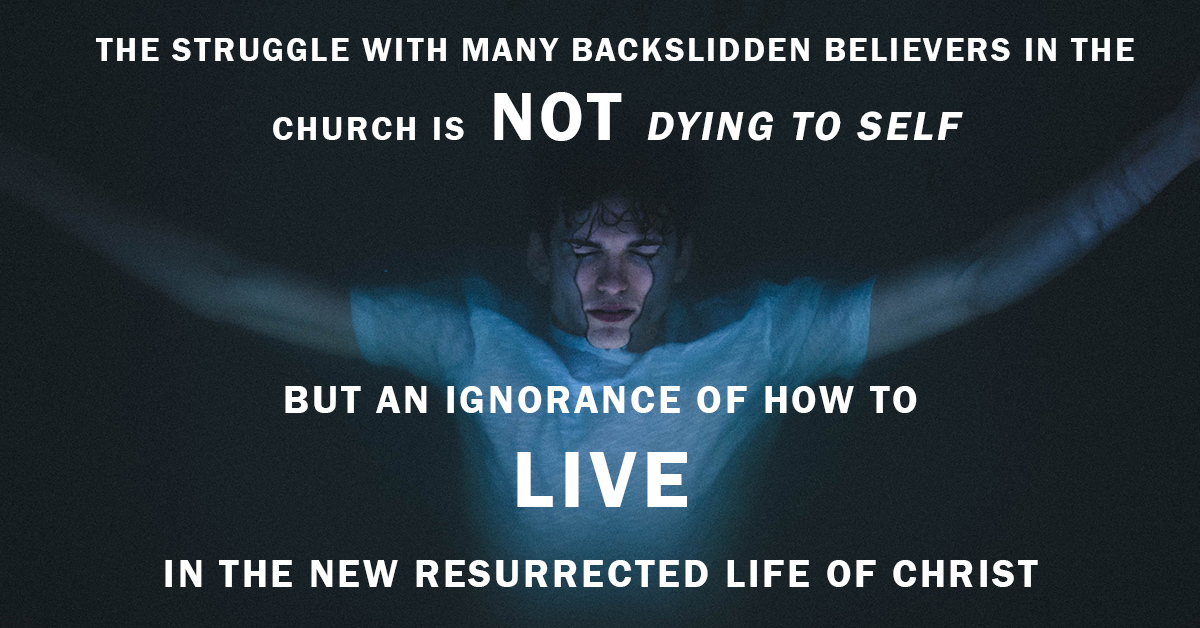
The church talks a lot about dying to self but may I submit that the issue many have in the church is not how to die to self but how to live in the new resurrected life of Christ? If someone is continually struggling in sin, we say, “Well, that person hasn’t learned how to fully die to self.” Why is it we do not also consider this possibility, that the person has not been shown and taught how to live in Christ?
Has the church been displaying a half baptism gospel?
That is, when a person is baptized into water, upon immersion underwater, this symbolizes us partaking in the death of Christ. But what about the latter part? The rising up out of the water then represents us partaking in the new resurrected life of Christ. Upon dying, are we now truly living?
Has the church limited baptism to just the baptism of John?
How many of us have been told that we should be baptized to publicly symbolize our repentance and confession of faith to Jesus? If this is our only understanding of baptism, then we have limited ourselves to just the baptism of John. In Acts 19:4 Paul explicitly says: “John baptized with the baptism of repentance, telling the people to believe in the one who was to come after him, that is, Jesus.”
It’s important to understand the full context of what Paul was saying here so here is the greater context of the passage in Acts 19:1-6:
And it happened that while Apollos was at Corinth, Paul passed through the inland country and came to Ephesus. There he found some disciples. And he said to them, “Did you receive the Holy Spirit when you believed?” And they said, “No, we have not even heard that there is a Holy Spirit.” And he said, “Into what then were you baptized?” They said, “Into John’s baptism.” And Paul said, “John baptized with the baptism of repentance, telling the people to believe in the one who was to come after him, that is, Jesus.” On hearing this, they were baptized in the name of the Lord Jesus. And when Paul had laid his hands on them, the Holy Spirit came on them, and they began speaking in tongues and prophesying.
In Luke 3:16, John himself clarifies this distinction between the baptism of John and the baptism of Jesus by saying:
I baptize you with water, but he who is mightier than I is coming, the strap of whose sandals I am not worthy to untie. He will baptize you with the Holy Spirit and fire.
Luke 3:16
The baptism of John does not include the new life in the Holy Spirit whereby we are enabled to live in victory over our fleshly desires.
How then are we to live in this new resurrected life in Christ?
Scripture tells us we are to do this through living by the Spirit. (Galatians 5:25). When Paul asked the disciples in Ephesus “Did you receive the Holy Spirit when you believed?”, what does this imply? It means it is possible for us to believe in Jesus and yet not have received the baptism of the Holy Spirit. It is possible for us to have put to death the consequences of the works of the flesh through repentance and receive forgiveness and yet not have received the empowerment of new life from the Holy Spirit.
Paul says in Ephesians 5:16:
But I say, walk by the Spirit, and you will not gratify the desires of the flesh.
Ephesians 5:16
Notice Paul does not say, “die to self” and you will not gratify the desires of the flesh. No, he says instead, “walk by the Spirit”.
So how are we to receive this empowerment of the Holy Spirit?
If you have already repented of your sins and received Jesus as your Lord and Savior, you need only ask and you will receive. In John 16:7 Jesus says: “Nevertheless, I tell you the truth: it is to your advantage that I go away, for if I do not go away, the Helper will not come to you. But if I go, I will send him to you.” And “Truly, truly, I say to you, whatever you ask of the Father in my name, he will give it to you. Until now you have asked nothing in my name. Ask, and you will receive, that your joy may be full.” – John 16:23-24
When we receive and submit to the Helper we inevitably will start producing the righteous fruits of the Holy Spirit which are: love, joy, peace, patience, kindness, goodness, faithfulness, gentleness, and self-control. (Galatians 5:22-23)
What am I saying in all of this? That it is not necessary to crucify the flesh in order to live in Christ? Absolutely not. For Scripture says, “I have been crucified with Christ and I no longer live” – Galatians 2:20 And “Those who belong to Christ Jesus have nailed the passions and desires of their sinful nature to his cross and crucified them there.” – Galatians 5:24 And “You were taught, with regard to your former way of life, to put off your old self, which is being corrupted by its deceitful desires” – Ephesians 4:22
What I am saying though is there are many believers in the church who are struggling to live a righteous life from a position of striving to die to self which has become an unnecessary yoke. We must not let the concept of “dying to self” become another shame-motivated, works-based effort to live righteously as that of circumcision. Ridding ourselves of our fleshly desires alone will not provide the victorious life in Christ.
It’s time for the church to rise up out of the water and let the Holy Spirit descend on us like a dove.
Let us receive and rely on the supernatural help of the Holy Spirit living inside us as beloved sons and daughters of God. I pray that you would let the Spirit renew your mind to put on your new nature, created to be like God—truly righteous and holy. (Ephesians 4:23-24)
 Bridal Crown Ministries